Why floors fail at the threshold first
Nobody photographs a doorway. It is still the part of the floor that tells you the most about who laid it.
September 8, 2026 · 3 min read
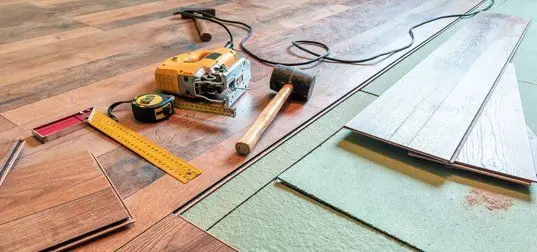
Ask somebody what they look at when they judge a floor and they will talk about colour, grain and finish. Ask a flooring contractor and they will look at a doorway. The threshold is where a floor is under the most stress and where the most decisions have to resolve at once, and it is almost always the first place a problem appears.
It is worth understanding why, because it changes what you ask for when you get a quote.
Four things have to agree in about four inches
At a transition you are managing height, movement, direction and fixing method, simultaneously, in a strip narrower than your hand.
- Height. Tile plus its bed sits at a different finished level to plank over underlayment. If those levels are not planned before either floor goes down, the fix is a ramp or a lip, and a lip is a trip hazard.
- Movement. Every material expands and contracts, and they do not do it at the same rate or in the same direction. Wood moves across its width with humidity. Tile moves with the slab under it. A rigid detail between two materials that move differently is a crack waiting for a season change.
- Direction. Plank has a grain direction and a run. Where that run meets a different material, the eye reads the join immediately if the line is not straight and square to the opening.
- Fixing. A floating floor and a fully bonded floor cannot be locked to each other. A floating floor has to be free to move, and pinning it at a threshold is one of the most common ways a good product ends up buckling in a hallway.
What goes wrong in Houston specifically
Two local conditions make thresholds harder here than they are in a drier climate. The first is humidity. Wood and wood-based products take on and give up moisture with the air, and the swing across a Houston year is significant. A floor laid tight in February has nowhere to go in August.
The second is what the building sits on. A great deal of Houston housing is slab on grade, and our clay soils move seasonally. That movement transmits into a tiled floor, which is why movement joints exist and why their placement is a design decision rather than an afterthought. When a tiled area runs from one room into another through a doorway, that doorway is very often exactly where a joint belongs.
What a good detail looks like
A well-handled threshold is one you stop noticing. The two finished surfaces meet at or very near the same height. The joint line is straight and square to the opening rather than following whatever the door frame happens to do. Expansion gaps are present but covered. The transition strip, if there is one, is fixed to the substrate rather than to either floor, so both floors remain free to move independently.
None of that is exotic. All of it takes a few extra minutes per doorway and a decision made before the first material is laid, rather than at the end when two crews meet in the middle.
Why splitting the job across trades causes it
Here is the practical reason thresholds get rushed. On a job where tile is one subcontractor, carpet is another and plank is a third, the transition belongs to nobody. It gets priced by whoever turns up last, and by then the heights are already fixed by decisions somebody else made weeks earlier.
That is a large part of why we bid whole floor packages rather than single materials. When one contractor is carrying every surface in the building, the levels get planned together and the transitions stop being an argument.
What to ask for
When you take a quote for a floor that involves more than one material, ask two questions. Who is responsible for the transitions, and how are the finished heights being planned. If the answer to the first is vague, you now know where the floor will fail.
Quality Interiors installs vinyl plank, hardwood, laminate, carpet, and tile and stone through one shop, which means the doorways between them are our problem. We have been doing it across Houston for over twenty-five years. Bids and estimates are free.
Quality Interiors LLC, (713) 501-1304
Call (713) 501-1304More articles
Which floor actually survives a Houston apartment turn
A unit turn is judged in days and in how the floor looks two tenants later. Those are different tests, and only some materials pass both.
Ceramic, porcelain, travertine, granite, marble: what each one actually does
They get sold side by side and talked about together. They do not behave the same way, and the differences show up in year three.