Ceramic, porcelain, travertine, granite, marble: what each one actually does
They get sold side by side and talked about together. They do not behave the same way, and the differences show up in year three.
September 8, 2026 · 3 min read
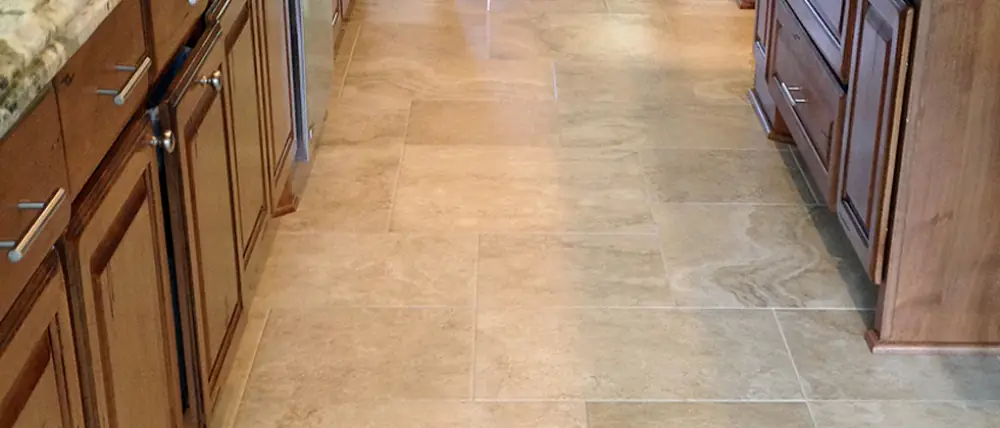
Tile and stone get grouped into a single aisle, which is convenient for a showroom and misleading for a homeowner. The five materials we install cover an enormous range of hardness, porosity and maintenance, and choosing between them on looks alone is how people end up with a beautiful floor that needs more attention than they were ever told about.
Here is what each one actually is, and the room it tends to suit.
Ceramic
Ceramic is the entry point, and for a lot of rooms it is entirely sufficient. It is fired clay with a glazed surface, it comes in more colours and formats than anything else on this list, and it is the easiest of the five to cut and set cleanly. In a low-traffic bathroom or a decorative wall application it does everything asked of it.
Its limit is the glaze. Chip through the surface and you are looking at the body of the tile underneath, which is usually a different colour. In a busy entry that takes grit and dropped objects, that shows.
Porcelain
Porcelain is fired denser and harder, and it absorbs far less water. That density is why it takes traffic ceramic will not, and why it is the usual answer for commercial floors, entryways and anywhere that gets both water and footfall. Through-body porcelain carries its colour all the way through, so a chip is far less visible.
It is harder to cut, which is a fair trade. On a diamond set or a complicated layout that cutting difficulty is real work rather than a footnote, and it is one of the places experience shows up in the finished floor.
Travertine
Travertine is a natural stone, and it behaves like one. It is formed with voids running through it, which is what gives it that soft, pitted, sunlit character people fall for. Those voids are usually filled at the factory, and over years some of them open up again.
It is also porous, which means it wants sealing and it wants resealing. Travertine in a hallway is a genuinely beautiful floor. Travertine in a kitchen where oil gets spilled and left is a maintenance commitment, and it is better to know that going in than to discover it.
Granite
Granite is about the hardest thing most floors will ever carry. It resists scratching in a way nothing else on this list matches, it is far less porous than travertine or marble, and it takes a polish that holds. If a floor is going to see abuse and you want stone rather than porcelain, this is the stone.
The trade-off is weight and workability. Granite is heavy, it is slow to cut, and the slab or tile format you choose changes the whole layout conversation.
Marble
Marble is the one people want for the look, and it is worth being honest about what owning it involves. It is softer than granite, it is porous, and it reacts to acid. A lemon slice or a splash of vinegar left on an unsealed marble floor can etch it, and etching is not dirt. It is a change in the surface itself.
None of that makes marble a bad floor. It makes it a floor for a room where it will be looked after, and a poor choice for a house with three children and a dog. That is a lifestyle question more than a materials question.
Layout matters as much as material
Whichever of the five you land on, the decisions that determine how the floor looks in ten years are made before anything is fixed down. Where the centreline runs. Which wall the cut tiles get pushed toward, because there is always a cut wall and the only question is whether you chose it. How the pattern meets a doorway. Where the movement joints sit.
A long hallway exposes a bad centreline call at the far end, where the cuts get progressively stranger. A diamond set turned forty-five degrees doubles the number of cuts and leaves nowhere to hide a poor one. Those are the layouts where you find out whether the crew measured or guessed.
We have been setting these five materials in Houston for over twenty-five years. If you are weighing two of them against each other for a specific room, tell us the room and how it gets used, and we will give you a straight answer. Bids are free.
Quality Interiors LLC, (713) 501-1304
Call (713) 501-1304More articles
Which floor actually survives a Houston apartment turn
A unit turn is judged in days and in how the floor looks two tenants later. Those are different tests, and only some materials pass both.
Why floors fail at the threshold first
Nobody photographs a doorway. It is still the part of the floor that tells you the most about who laid it.